Hell Let Loose: Vietnam Attracts Battlefield Veterans and Reveals M16A1 Details in New Armoury Series
Expression Games kicks off the Inside the Armoury series with the M16A1 and M203, while the tactical shooter's learning curve humbles incoming Battlefield players.
The road to the August 13, 2026 release of Hell Let Loose: Vietnam has been paved with intense community feedback, extensive beta testing, and a steady drip of official reveals from Expression Games and Team17. As the developers prepare to launch their Unreal Engine 5 reimagining of the massive 50v50 tactical shooter across PC, PlayStation 5, and Xbox Series X|S, two distinct narratives have emerged over the past week.
On one front, the studio is heavily emphasizing historical authenticity with the premiere of their new video series dissecting 1960s weaponry. On the other front, a fascinating cultural shift is occurring within the player base itself. Driven by the allure of airmobile helicopter assaults and massive jungle environments, veterans from mainstream arcade shooters are migrating to the game—and many are experiencing a harsh reality check.
Inside the Armoury: The M16A1 and M203
Expression Games has officially launched the first episode of “Inside the Armoury,” a video series born from their collaboration with the UK’s Royal Armouries Museum. Hosted by Jonathan Ferguson, the Keeper of Firearms and Artillery, the series breaks down the real-world history and in-game mechanics of the arsenal coming to the Vietnam-era shooter. If you want to know more about how this partnership came to be, you can review our background piece on the Royal Armouries weapon partnership.
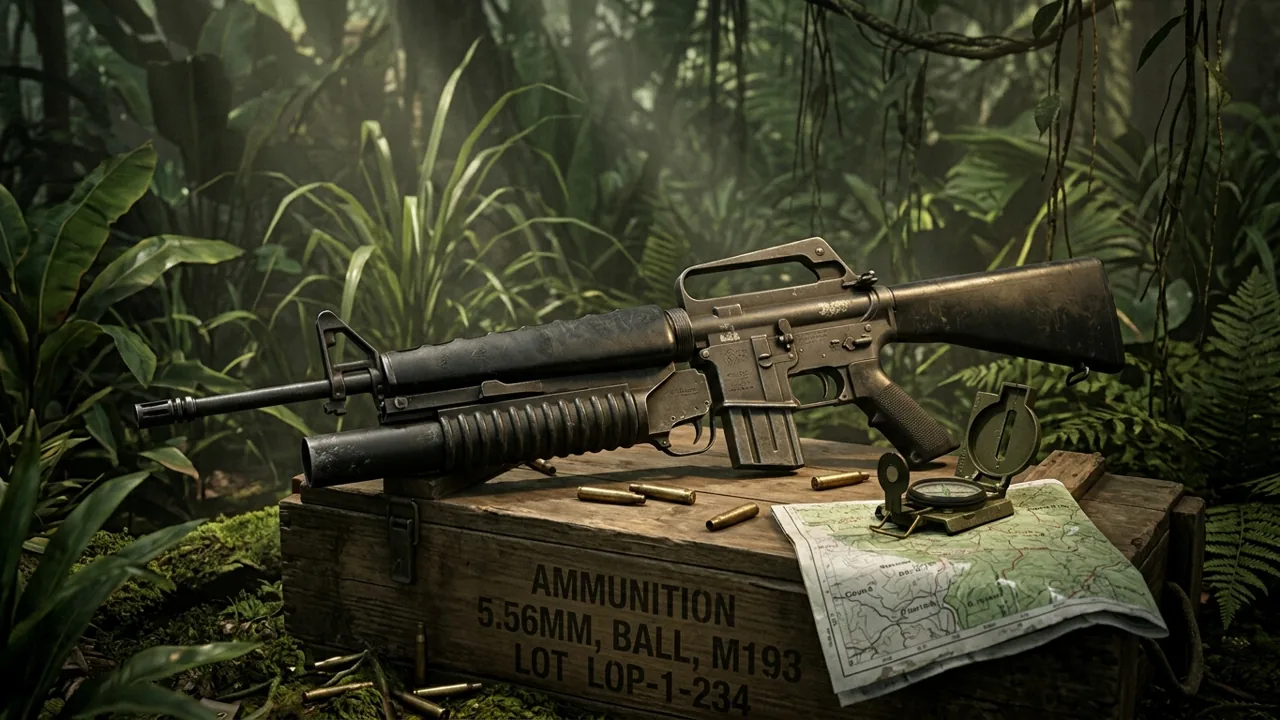
Episode one places the spotlight squarely on the iconic M16A1 assault rifle, paired with the M203 underbarrel grenade launcher. For the United States military faction, the M16A1 serves as the undisputed backbone of their infantry squads. Moving away from the heavy, semi-automatic M1 Garand of the original World War II title, the M16A1 introduces a lightweight, high-velocity, select-fire platform that fundamentally changes how infantry engagements play out. In the dense foliage of the game’s six launch maps, rate of fire and sheer volume of suppression will often dictate who wins a firefight before the enemy is even visibly spotted.
The integration of the M203 underbarrel grenade launcher is reportedly expected to significantly alter infantry tactics for the Grenadier class. In a landscape dominated by the NVA and Viet Cong’s extensive underground networks, indirect explosive fire becomes a crucial tool for survival. Players will need to effectively use the M203 to clear out entrenched jungle bunkers, disrupt ambushes from heavy brush, and potentially destroy enemy spawn points from a safe distance. The authentic modeling of the weapon, down to the intricate reloading animations and sight alignment, reinforces the developer’s commitment to strict realism over casual run-and-gun mechanics. For a broader look at the confirmed arsenal for both factions, you can read our full weapons guide.
A Culture Clash: Humbling the Arcade Shooter Veteran
While the development team meticulously crafts authentic 1960s hardware, the community servers are experiencing a massive influx of new blood. A recent editorial by Yahoo News accurately captured this phenomenon, highlighting that Hell Let Loose: Vietnam was deliberately “built to humble Battlefield players.” With Battlefield 6 continuing that franchise’s traditional arcade-oriented legacy, countless players seeking a more grounded, immersive, and high-stakes experience have jumped into the recent Hell Let Loose: Vietnam playtests.
However, the transition for these newcomers is rarely a smooth one. The asymmetrical warfare of the 1965–1973 setting—where the US forces rely heavily on air mobility and brute firepower, while the North Vietnamese Army (NVA) and Viet Cong (VC) utilize stealth, booby traps, and complex tunnel systems—demands a level of communication and patience rarely required in mainstream titles.
There are no mini-map enemy indicators here, no 3D spotting triangles hovering above heads, and a brutal time-to-kill (TTK) that frequently sends players back to the deployment screen after a single, unseen shot from the treeline. Players who are accustomed to lone-wolfing objectives are quickly finding themselves bogged down in muddy rice paddies, hopelessly separated from their squad, and systematically eliminated. The shift in pacing requires a complete rewiring of fundamental FPS instincts. Teamwork is not just encouraged; it is the sole metric of success.
The Helicopter Reality Check
Nowhere is this culture clash more evident than in the pilot’s seat of the UH-1 Huey helicopter. In a recent community discussion thread, a self-identified Battlefield transport pilot shared their experience transitioning to Hell Let Loose: Vietnam. Drawn to the game by the prospect of flying the iconic helicopters, they noted that while they enjoyed the flight model in the beta, they felt they were missing something regarding the aircraft’s true tactical impact. They found themselves flying aimlessly, unsure of how to contribute beyond simple point-to-point transportation.
In arcade shooters, transport helicopters often serve as a mobile, mid-air spawn point and a stable platform for door gunners to effortlessly rack up kills. In this game, however, the air cavalry is deeply integrated into the commander’s logistics network. Veteran players were quick to point out that effectively flying a helicopter requires constant, precise communication over the officer radio channel. Pilots are not just dropping off riflemen; they are fundamentally responsible for running essential supply crates to establish forward garrisons, ferrying the Commander to high vantage points for battlefield observation, and firing illumination flares to light up the dark jungle canopy during intense night engagements.
Furthermore, coordinating with Squad Leaders on the ground to secure volatile landing zones is an absolute necessity. A Huey hovering aimlessly over a hot zone is nothing more than a massive, noisy target for NVA RPG-7s and heavy anti-air machine gun emplacements. The role demands high situational awareness, accurate map reading, and a deep understanding of the macro-strategy of the 50v50 match, rather than just raw stick-flying skills. For those looking to genuinely master the skies and support their team, our detailed helicopter guide offers an extensive look into flight mechanics and inter-squad coordination.
Navigating the Jungle: The Ongoing Pacing Debate
The influx of aggressive, fast-paced players has also sparked a debate about the game’s overall movement pacing. Another community thread recently highlighted a growing concern that the infantry gameplay in the Vietnam iteration feels somewhat faster than the original World War II title. The abundance of bushes, tall grass, and dense tropical vegetation allows players to move through the jungle largely unseen, which some community members argue makes it entirely too easy to rush strongpoints without consequence.
Veterans of the original game are actively advocating for slower movement speeds, particularly when traversing dense brush or wading through the game’s new river systems, to recreate the suffocating tension of historical jungle warfare. The argument is that the environment itself should force careful, methodical movement rather than facilitating quick, arcade-style flanks.
While Expression Games has not officially confirmed any major tweaks to the base infantry movement speed, the developer is known to closely monitor beta feedback. Adjustments to stamina drain or speed penalties while moving through heavy foliage could be expected in future patches leading up to the official release. You can read more about how the terrain impacts strategy in our maps guide.
Looking Ahead to August
As the August 13 release date approaches, the community dynamic is settling into a fascinating, slightly chaotic rhythm. The developers are providing the authentic historical tools—like the meticulously crafted M16A1 and the logistical heavy-lifting of the UH-1 Huey—while the community is collectively learning the hard lessons of tactical discipline.
For players coming from faster-paced, mainstream shooters, Hell Let Loose: Vietnam offers a steep but incredibly rewarding learning curve. It is a title where a well-coordinated helicopter supply run, or a disciplined squad holding a defensive line in the thick jungle mud, is just as satisfying as achieving a high personal kill count. As we await further episodes of “Inside the Armoury” and more official deep dives into the asymmetrical factions, players would do well to study up on the specific roles and classes to prepare for one of the most unforgiving virtual battlefields in the genre.