Hell Let Loose Vietnam: Community Debates M16A1 Ammo Economy and Explores Frame Generation
An in-depth analysis of the M16A1 versus Type 56 loadout disparity in Hell Let Loose Vietnam, and how players are utilizing Frame Gen to combat UE5 performance drops.
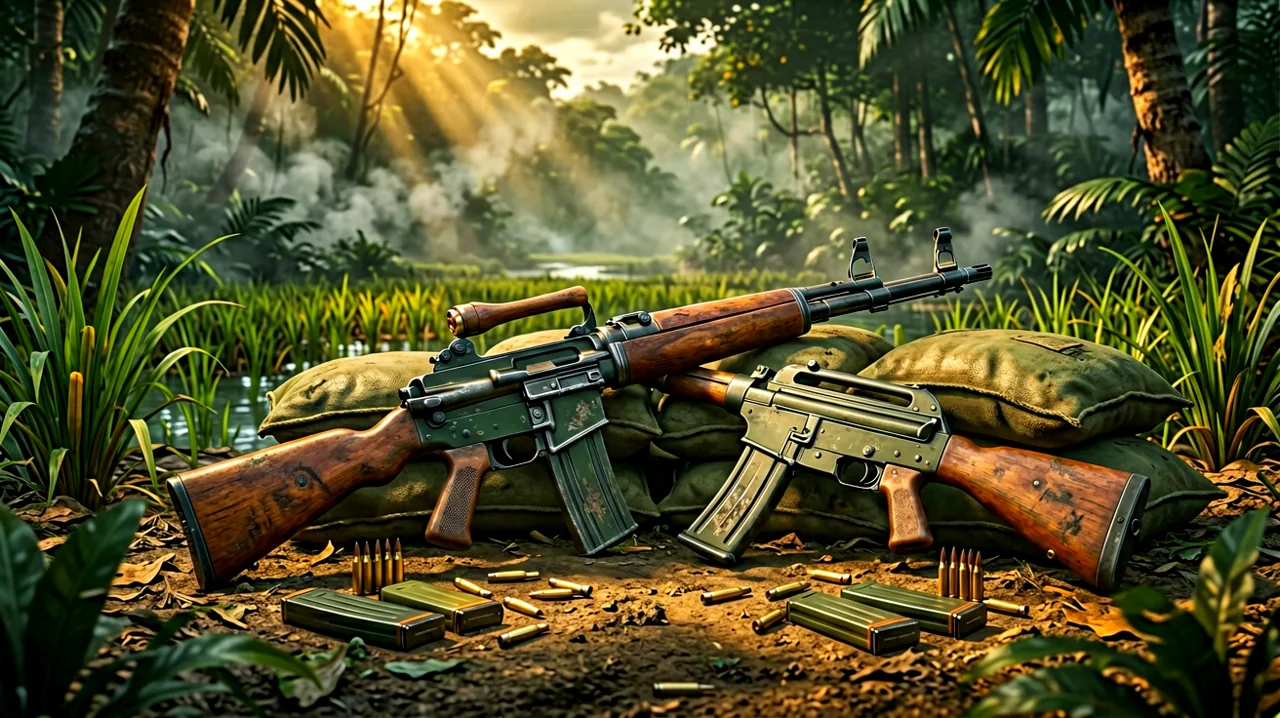
Hell Let Loose Vietnam fundamentally alters the 50v50 large-scale tactical shooter formula by leaning heavily into asymmetrical warfare. Instead of the relatively mirrored forces seen in the World War II European theater, Expression Games has designed an environment where the United States military’s air mobility clashes violently against the North Vietnamese Army (NVA) and Viet Cong’s subterranean networks. However, as the player base logs thousands of hours in the dense jungles, a massive debate has ignited surrounding the core infantry balance—specifically, the stark difference in the ammunition economy between the standard-issue M16A1 and the Type 56 assault rifles.
Simultaneously, the transition to Unreal Engine 5 continues to heavily tax modern PC hardware, leading community members to desperately experiment with Temporal Super Resolution (TSR) and Frame Generation technologies. The ongoing discourse provides a fascinating look into the growing pains of a highly ambitious military simulator trying to balance historical accuracy with enjoyable moment-to-moment gunplay.
The Asymmetrical Ammo Economy: 80 Rounds vs. 120 Rounds
The rivalry between the M16 platform and the AK platform is one of the most iconic equipment clashes in military history. The Vietnam War served as the primary proving ground where the inventions of Eugene Stoner and Mikhail Kalashnikov first met in widespread, direct combat. Hell Let Loose Vietnam authentically recreates both legendary firearms, assigning the M16A1 to the US forces and the Type 56 (a Chinese copy of the Soviet AK-47) to the NVA.
Currently, the loadout economics for these weapons are heavily scrutinized by the community. Based on current game builds, both the M16A1 and the Type 56 cost exactly four weight points to equip in a player’s loadout. Yet, their raw combat sustainability is vastly different. The US infantryman equipped with the M16A1 spawns into the combat zone with four 20-round magazines, granting a total of 80 rounds of 5.56x45mm ammunition. Conversely, the NVA soldier carrying the Type 56 deploys with four 30-round magazines, holding a total of 120 rounds of 7.62x39mm ammunition.
This creates a scenario where the NVA faction enjoys a massive 33.33% advantage in standard rifle ammunition straight out of the spawn point. While some players correctly point out that this is entirely historically accurate—early US deployments in Vietnam relied heavily on the smaller 20-round magazines before field improvisations and later logistics introduced 30-round variants—it creates significant friction in a balanced video game ecosystem. You can review our detailed breakdown of how these weapons were initially implemented in our M16A1 reveal coverage.
Tactical Implications on the Battlefield
In a game where suppression mechanics heavily distort enemy vision and limit their combat effectiveness, the volume of fire is king. The NVA’s 120-round pool allows standard riflemen to aggressively spray dense tree lines, lay down continuous covering fire for advancing squads, and comfortably hold defensive positions without immediately crying out for resupply. This perfectly complements their faction design, which revolves around persistent, localized defense using tunnel networks and booby traps.
The US forces face a very different reality. Firing an M16A1 on fully automatic can deplete a 20-round magazine in roughly 1.5 seconds. In chaotic firefights during a hot LZ insertion via Huey helicopter, a US rifleman can burn through their entire 80-round combat load in just one or two engagements. This forces the American team into a much tighter dependency on their logistical chain.
The Support role becomes absolutely critical for the US faction. Without a Support player actively dropping explosive and standard ammo boxes, a US infantry squad advancing through the jungle will quickly find themselves resorting to sidearms or melee combat. Similarly, the US Commander is heavily pressured to utilize resource nodes for constant aerial supply drops just to keep the frontline firing. If you want to master this heavy logistical burden, consult our roles and classes guide.
Community Proposed Adjustments
Players are not merely complaining; the community has generated several compelling solutions to level the playing field without destroying the historical immersion that defines the series.
- Adjusting the Starting Magazine Count: The most prominent suggestion is to increase the M16A1’s starting inventory from four magazines to five or six. Providing the US player with 100 or 120 rounds via extra 20-round magazines preserves the historical accuracy of the equipment while balancing the overall ammunition pool. It simply shifts the penalty to frequent reloading rather than absolute ammunition starvation.
- Weight System Revisions: If the developers firmly believe the Type 56 should retain its 120-round superiority, the community argues it should cost more weight points. Making the Type 56 cost five weight points instead of four would force NVA players to sacrifice utility items—such as a fragmentation grenade, a smoke grenade, or a bandage—to carry that extra firepower.
- Weapon Recoil as a Balancing Factor: Defenders of the current system point out that the 5.56x45mm round fired from the M16A1 has significantly less recoil than the 7.62x39mm round of the Type 56. The M16A1 is objectively easier to handle in medium-to-long range engagements. A skilled US player can potentially secure more kills with 80 precise rounds than an NVA player spraying 120 heavily recoiling rounds.
It is reportedly not yet confirmed if Expression Games intends to patch the starting ammunition counts, but they have a track record of listening to balance feedback, as seen in the recent patch 1.3 tunnel nerfs.
PC Performance Hurdles: TSR and Frame Generation
While weapon balance dominates tactical discussions, technical performance remains a persistent barrier for many PC players. The staggering density of the Vietnam jungle environments rendered in Unreal Engine 5 is pushing modern hardware to its absolute limits.
A highly discussed technical report within the community recently shed light on mid-range performance expectations. A player utilizing an AMD Ryzen 5 8400F CPU paired with a Radeon RX 9060XT GPU and 32GB of RAM shared their struggles at 1080p resolution. Utilizing a mixture of High and Epic custom settings alongside Native TSR (Temporal Super Resolution), the system only managed to output 60 FPS, with severe dips down into the low 50s during artillery barrages or heavy helicopter traffic.
For a slow-paced, methodical shooter where identifying a helmet pattern in the brush hundreds of meters away is required, dipping below a stable 60 FPS is heavily detrimental to the gameplay experience. This has led many players to explore modern upscaling and Frame Generation workarounds. To see how these issues align with official developer statements, check our system requirements guide.
The Verdict on Frame Generation in a Hardcore Shooter
Frame Generation (whether via DLSS 3 for Nvidia users or FSR 3 for AMD users) artificially inserts generated frames between real rendered frames to boost visual smoothness. While theoretically ideal for a game struggling to maintain high framerates, the Hell Let Loose Vietnam community is largely divided on its actual utility due to the specific demands of the tactical shooter genre.
The Pros: For players operating armor or serving in logistics roles, Frame Generation is largely viewed as a positive. If your base framerate is hovering around 50 FPS (like the RX 9060XT user), enabling Frame Generation can artificially push the display to over 90 FPS, creating a much smoother visual panning experience when scanning the horizon from a river patrol boat or a tank commander’s cupola.
The Cons: However, for frontline infantry—especially roles reliant on twitch reflexes and precision, like the Sniper or standard Rifleman—Frame Generation introduces severe drawbacks.
- Input Latency: The technology inherently introduces a slight delay in mouse input. In close-quarters trench clearing or sudden jungle ambushes, those extra milliseconds of input lag frequently result in losing a gunfight.
- Visual Artifacts: Fast movements, particularly when aiming down iron sights, can cause the generated frames to smear or create ghosting artifacts. Spotting enemies is already difficult in the game’s dense vegetation; adding visual noise around moving objects makes target acquisition incredibly frustrating.
- TSR Superiority: Many veteran players report that relying on Native TSR provides the absolute cleanest image clarity for long-range target identification, arguing that it is better to play at a stable, lower framerate with TSR than to endure the visual artifacts introduced by aggressive upscaling and frame generation.
Looking Ahead
As the dust settles following the game’s initial launch period, Hell Let Loose Vietnam is proving to be an uncompromising military experience. The developers at Expression Games have bravely embraced asymmetric warfare, forcing players to adapt to wildly different faction strengths and logistical limitations. The debate over the M16A1 versus the Type 56 is symptomatic of a larger design philosophy that prioritizes historical friction over perfectly mirrored esports balance.
Meanwhile, the battle for stable performance rages on. Until further optimization patches are deployed by the development team, PC players will need to carefully weigh the trade-offs between visual fidelity, framerate smoothness, and input latency. We expect further dialogue from the developers on both the weapon economy and engine performance in upcoming community briefings.