Hell Let Loose: Vietnam Community Highlights: Extreme Huey Formations and 1960s Real-World Arsenals
Community-reported achievements in Hell Let Loose: Vietnam showcase intense Huey helicopter formations, riverboat combat, and an obsession with historical 1960s weapons.
Redefining Tactical Combat in the Jungle Sandbox
With Hell Let Loose: Vietnam scheduled to deploy on August 13, 2026, the dedicated player base is already proving just how drastically the transition from World War II to the 1965–1973 theater will alter the established gameplay loop. Expression Games and Team17 have rebuilt the franchise utilizing Unreal Engine 5, aiming to deliver a brutal, asymmetrical 50v50 experience on PC (Steam/Epic/Microsoft Store), PlayStation 5, and Xbox Series X|S. While crossplay between PC and consoles is reportedly not supported at launch, the community across all platforms is actively dissecting every available mechanic during the pre-launch testing phases.
The sandbox provided by the developers introduces three massive new systems: helicopter air mobility, intricate NVA/VC tunnel networks, and dynamic river combat. Today, we are looking at how the player base is interacting with these tools, highlighting some remarkable community-reported feats. From pilots executing extreme aerial maneuvers to players taking their dedication for historical authenticity into the real world, the community is already shaping the meta long before the official release day.
The High-Stakes Art of Helicopter Formation Flying
The introduction of the UH-1 Huey is arguably the most significant shift in the Hell Let Loose franchise’s history. These iconic machines serve as mobile spawn points, rapid transport, and close air support, completely replacing the slow, methodical logistics trucks of the European theater. As we previously analyzed in our helicopter guide, the flight model is heavily physics-based, punishing sudden movements and rewarding smooth momentum management.
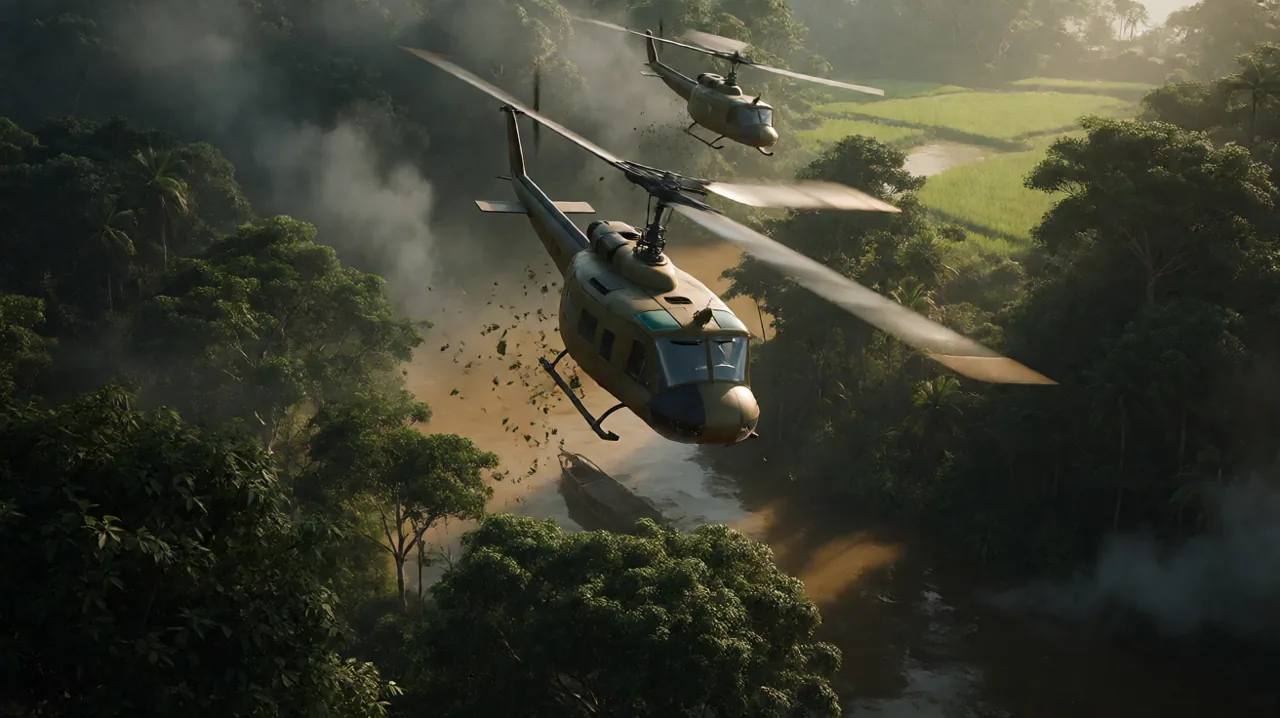
Recently, the community was treated to a spectacular display of aerial proficiency. A pilot, known on the subreddit as /u/MrLaughingFox, shared gameplay footage demonstrating an incredibly tight formation flight alongside another Huey pilot. The two aircraft skimmed the dense jungle canopy mere meters apart, a maneuver that almost resulted in a catastrophic mid-air collision. In the context of Hell Let Loose: Vietnam, this is not merely a stunt; it represents a highly evolved tactical necessity.
Coordinating multi-helicopter insertions is expected to become a cornerstone of high-level competitive play. Landing a single squad of six infantrymen into a contested clearing often results in them being immediately pinned down by North Vietnamese Type 56 fire. By flying in tight formations, US forces can deliver an entire platoon simultaneously, overwhelming the defenders through sheer numbers and the suppressing fire of multiple M60 door gunners.
However, the margin for error is razor-thin. A collision means the instant loss of critical tickets, the destruction of two high-value assets, and an immediate logistical blackout for the ground forces who were relying on that deployment. The fact that community members are already practicing these high-risk, high-reward maneuvers indicates that the skill ceiling for dedicated pilots will be astronomically high. It also underscores the importance of proximity voice communication, as pilots must coordinate their pitch, yaw, and landing approaches perfectly to avoid crashing amidst the chaotic 3D audio landscape.
Asymmetric Warfare: Hueys Hunting Riverboats
The same pilot who achieved the death-defying formation flight also reported a staggering combat milestone: independently destroying 10 enemy riverboats in a single match. This single community-reported statistic perfectly encapsulates the asymmetrical design philosophy driving Hell Let Loose: Vietnam.
In the WWII iterations, vehicle combat was generally symmetrical—Sherman tanks slugging it out with Panthers across open fields or within the hedgerows of Normandy. In the jungles of Vietnam, the US military leverages overwhelming air superiority, while the NVA and Viet Cong utilize the environment itself. The North Vietnamese factions rely heavily on wooden boats and patrol craft to navigate the complex delta regions and flooded rice paddies. As outlined in our coverage of river boats strategy, these vessels function as vital logistical arteries, moving troops and supplies to establish forward garrisons completely hidden from land-based patrols.
The dynamic between the Huey and the riverboat is a fascinating cat-and-mouse game. A skilled helicopter crew can completely sever the NVA’s aquatic supply lines. Spotting the faint wake of a boat moving through murky water requires sharp eyes, and engaging it requires the pilot to bank the helicopter, giving the door gunners a clear line of sight while remaining evasive enough to dodge return fire. Taking down 10 boats single-handedly is a monumental achievement that actively cripples the enemy team’s ability to maintain map control along the waterways.
Conversely, the NVA must adapt. The community is already learning that lingering on the open water is a death sentence. Boat operators must use the overhanging vegetation, morning fog, and heavy rain weather effects to mask their movements. If a Huey is spotted, standard procedure dictates cutting the engine and seeking cover in the dense reeds, or drawing the helicopter low enough to spring an ambush with RPGs and concentrated small arms fire. This vertical, air-to-water interplay is entirely new to the franchise and is proving to be incredibly engaging for both factions.
Translating Digital Authenticity to Real-World Arsenals
The impact of the game’s historical realism is bleeding over into real life, demonstrating the immersive power of Expression Games’ weapon design. The developers have meticulously recreated the firearms of the 1960s, capturing the specific auditory signatures, visual quirks, and handling characteristics of each weapon in Unreal Engine 5.
This attention to detail has sparked a wave of historical enthusiasm within the community. Player /u/km1697369 recently shared a post detailing how their experience with the game inspired them to start collecting physical, real-world counterparts to the in-game arsenal. The player acquired a WASR 10/63 (a popular real-world stand-in for the VC’s AK variants), began assembling an H&R M16A1 upper receiver to clone the iconic US service rifle, and purchased a Tisas 1911 sidearm. They noted that while the game itself was a standard purchase, their newfound passion for physical historical collecting quickly ran into the thousands of dollars.
This level of community dedication highlights the success of the game’s infantry combat loop. As detailed in our comprehensive weapons guide, the choice of firearm drastically dictates a player’s role on the battlefield. The M16A1, with its distinct carry-handle aperture sights, excels at holding accurate sightlines across open terrain and rice paddies. Its distinctive “crack” echoing through the valley is an immediate tactical indicator for the NVA. On the other side, the heavier recoil and devastating stopping power of the NVA’s assault rifles make them unyielding tools for tunnel defense and sudden, point-blank jungle ambushes.
When a tactical shooter can inspire players to seek out the physical weight, wood, and steel of its digital assets, it confirms that the developers have successfully captured the essence of the era. The audio design—from the metallic clatter of an empty magazine hitting the mud to the specific mechanical cycling of the bolts—is clearly resonating with military history enthusiasts and elevating the standard for the genre.
The Evolving Landscape Ahead of Launch
As the August 2026 launch approaches, these community spotlights paint a picture of a healthy, deeply invested player base. The tactical sandbox is working precisely as intended, fostering emergent gameplay moments that cannot be rigidly scripted.
For leadership roles, the implications are massive. Commanders must view the map not just as a 2D plane, but as a layered 3D environment. They must coordinate the airspace, ensuring Hueys are safely routing around known NVA anti-air hotspots, while simultaneously managing the ground and river offenses. If US pilots continue to rack up massive boat kill counts, NVA commanders will be forced to rely heavier on the underground network. As our tunnel guide explores, these subterranean routes offer complete immunity from aerial bombardment, shifting the focus back to grueling, close-quarters infantry meat-grinders.
Expression Games is undoubtedly analyzing these community trends. While the current balance allows for spectacular air-to-surface victories, ongoing patches may adjust the survivability of rivercraft or refine the helicopter collision models to account for server latency. Regardless of minor pre-launch tweaks, the core identity of Hell Let Loose: Vietnam has been firmly established by the players themselves. It is a game of brutal asymmetry, requiring constant communication, severe situational awareness, and a deep respect for the lethal tools of the 1960s battlefield.