Why Hell Let Loose: Vietnam Dropped Booby Traps for Large-Scale NVA Battles
Expression Games confirmed Hell Let Loose: Vietnam will not feature guerrilla booby traps, shifting the focus entirely to conventional large-scale US vs NVA warfare.
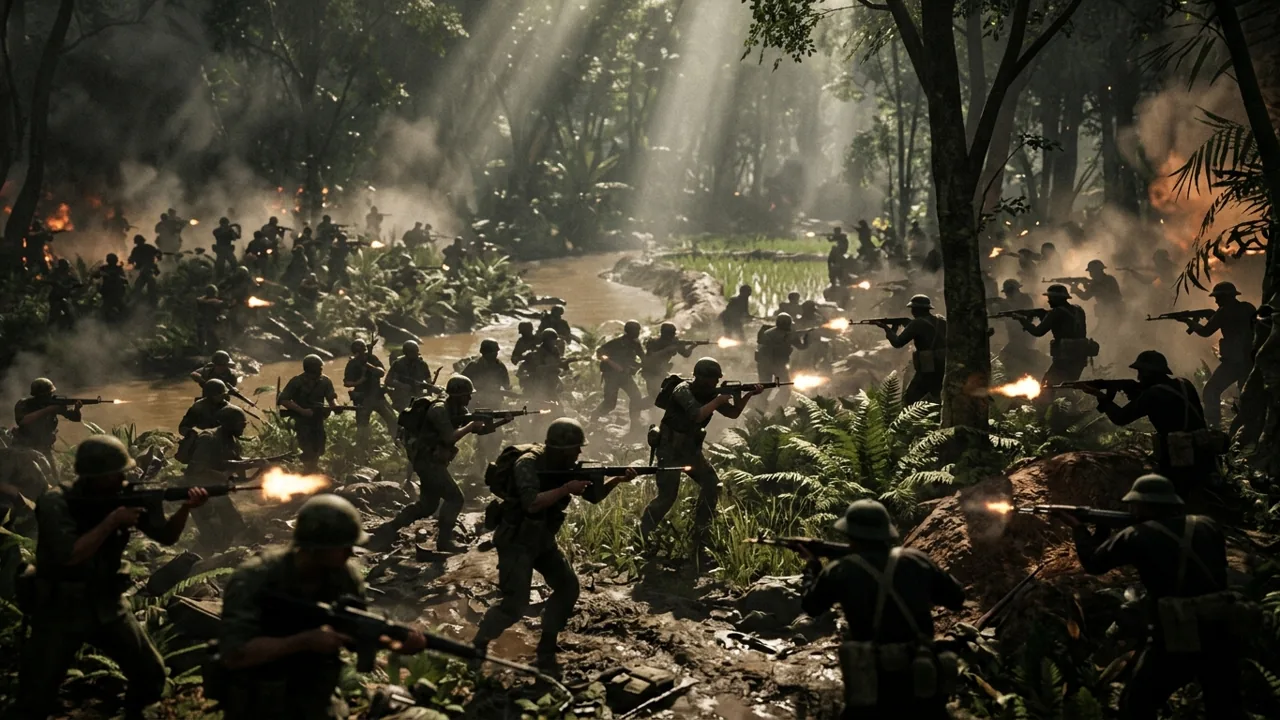
As the clock ticks down to the highly anticipated August 13 launch of Hell Let Loose: Vietnam, the community is buzzing with last-minute revelations. Expression Games and Team17 are preparing to transport their massive 50v50 tactical shooter formula from the European theater of World War II to the dense jungles, sprawling rice paddies, and winding rivers of Southeast Asia. While players are eager to pilot UH-1 Huey helicopters and navigate intricate subterranean networks, a recent developer confirmation has sparked a heated debate across community forums: the infamous booby traps synonymous with the Vietnam War will not be featured in the game.
This decision marks a significant philosophical shift in how the developers are approaching the historical conflict. Rather than focusing on the asymmetric, hit-and-run guerrilla warfare often associated with the Viet Cong, the upcoming title is doubling down on large-scale, conventional military engagements between the United States Armed Forces and the North Vietnamese Army (NVA).
The following breakdown examines the reasoning behind this controversial omission, how it will shape the moment-to-moment infantry combat, and what it means for confirmed battlefields like the Thanh Hóa Bridge and Đắk Tô Airfield ahead of tomorrow’s launch.
The Developer’s Decision: No Booby Traps
When tactical shooter fans envision a Vietnam War video game, certain environmental tropes immediately come to mind. Punji stake pits hidden beneath the brush, tripwire-rigged artillery shells, and bouncing betties concealed on jungle trails are often considered essential elements for establishing the era’s tense atmosphere. For months during the pre-release cycle, the community speculated on how Hell Let Loose: Vietnam would implement these hazards to balance the overwhelming aerial superiority of the US factions.
However, recent discussions highlighted by the community confirm that Expression Games will forego the implementation of these defensive traps. The core reasoning provided points toward a deliberate design choice to focus entirely on large-scale military conflicts, coupled with the technical realities of running a 100-player server on Unreal Engine 5. Implementing physics-based traps that can dynamically affect players across a massive 2x2 kilometer map introduces severe performance bottlenecks. Ensuring smooth server tick rates and maintaining the system requirements for a stable frame rate took priority over static environmental hazards.
Beyond the technical hurdles, the exclusion of traps fundamentally alters the pacing of the game. In a title where the time-to-kill (TTK) is already punishingly low, dying to an invisible tripwire left by a player who might have redeployed to the other side of the map can lead to severe frustration. By removing these passive hazards, the developers are forcing players to rely on active defensive measures, such as establishing robust garrisons, coordinating squad crossfire, and utilizing the newly introduced tunnel networks for ambushes.
Shifting the Focus: NVA Regulars vs. US Military
To understand the lack of booby traps, it is crucial to recognize the specific scope of the game. The Vietnam War was an incredibly complex conflict, encompassing both widespread guerrilla insurgencies and massive, conventional battles involving thousands of troops. While the Viet Cong relied heavily on traps and asymmetric warfare to bleed American forces in the countryside, the North Vietnamese Army was a well-equipped, organized military force capable of executing large-scale offensives.
Expression Games has chosen to spotlight these conventional clashes. The game’s 50v50 structure naturally lends itself to organized frontlines, heavy artillery barrages, and coordinated infantry pushes. The NVA faction is equipped with heavy weaponry, standardized communication structures, and established supply lines that mirror their real-world capabilities during major operations. You can read more about how the distinct forces operate in our factions guide.
This means that while the US forces will dominate the skies with helicopter air assaults, the NVA will counter with heavy anti-air emplacements, entrenched fortifications, and rapid redeployment via tunnels—not passive spike pits. When a squad is wiped out while patrolling the jungle, it will be the result of a well-placed enemy machine gunner or an artillery strike called in by a competent commander, rather than an unexploded ordnance hidden in the mud.
Analyzing the Battlefields: Đắk Tô Airfield and Thanh Hóa Bridge
The developer’s focus on conventional warfare is heavily reflected in the map design. Community discussions and recent map overviews have frequently referenced two iconic locations that perfectly encapsulate this design philosophy: Đắk Tô Airfield and the Thanh Hóa Bridge.
Đắk Tô Airfield represents a critical strategic military objective. Historically, the battles around Đắk Tô involved massive troop movements, relentless artillery bombardments, and fierce infantry assaults up heavily contested hillsides. In the game, an airfield provides a wide-open, high-value target that both teams must fight tooth and nail to control. This is an environment where standard traps would be largely ineffective or destroyed by the sheer volume of high explosives. Instead, success on this map will rely on armor support, precision air strikes, and coordinated squad pushes across exposed terrain, rewarding aggressive tactics over passive defense.
The Thanh Hóa Bridge, widely known as the Dragon’s Jaw, offers a completely different yet equally conventional combat scenario. This vital piece of infrastructure was the target of numerous US bombing campaigns and was heavily defended by NVA anti-aircraft batteries. In the game, this map will feature intense riverine combat and grueling chokepoint battles. The bridge itself will serve as a meat grinder, demanding tight squad coordination and effective use of smoke grenades to push across. The surrounding river deltas will see the deployment of the new aquatic combat systems, making it a dynamic, multi-tiered battlefield where controlling the waterways is just as important as holding the bridge. More details on the terrain layouts can be found in our comprehensive maps guide.
How the 1960s Arsenal Changes the Pacing
To compensate for the lack of traps, the infantry combat mechanics have been significantly overhauled to reflect the weaponry of the 1960s. The introduction of automatic fire as the standard issue fundamentally changes the engagement distances and lethality of the average rifleman. In the World War II iteration of the franchise, bolt-action rifles dominated the field, making every shot count and allowing for methodical pushes.
In Vietnam, the dense foliage will frequently be torn apart by suppressive fire. As detailed in our weapons guide, the widespread use of M16A1s and Type 56 assault rifles means that moving through the jungle is inherently dangerous even without hidden spikes. The NVA forces will utilize their unique firearms and RPGs to set up devastating crossfires, requiring US forces to constantly call in reconnaissance and artillery support before advancing. The absence of traps puts a heavier emphasis on the role of the Pointman and Squad Leader to visually identify enemy combatants hiding in the brush, relying on traditional scouting rather than scanning the dirt for tripwires.
Helicopters, Tunnels, and True Asymmetry
The true asymmetry of Hell Let Loose: Vietnam lies not in booby traps, but in faction mobility. The US military faction’s defining characteristic is their access to the UH-1 Huey. These aerial assets allow the US team to bypass traditional frontlines, dropping entire squads behind enemy positions to secure volatile landing zones. This mobility forces the NVA to play a more reactionary, anti-air focused game, utilizing heavy machine guns to swat transports out of the sky. The mastery of these vehicles is complex, and aspiring pilots should review the helicopter flight models before taking to the skies.
Conversely, the NVA relies on their intricate underground networks. While they might not be leaving bouncing betties on the trails, they can establish hidden subterranean garrisons that allow their infantry to appear seemingly out of nowhere. This mechanic replaces the area-denial aspect of traps with sudden, overwhelming numbers. A squad of US soldiers pushing through the jungle might not step on a punji stick, but they could suddenly find themselves surrounded by NVA troops pouring out of a concealed tunnel exit. Understanding how to dismantle these networks is crucial, as explained in our tunnel mechanics breakdown.
The Community Backlash and Historical Accuracy Debate
The confirmation that traps will not be included has predictably split the player base. On one side of the debate, military history enthusiasts and hardcore milsim players argue that omitting such a defining characteristic of the conflict damages the game’s authenticity. They feel that the constant paranoia of navigating the jungle—always checking the ground for disturbed earth or hidden wires—is essential to capturing the true tension and psychological toll of the Vietnam War.
On the other side, many competitive players and series veterans are breathing a sigh of relief. The original game is already notoriously punishing, with a steep learning curve that requires constant situational awareness. Introducing mechanics that kill players without any direct line of sight or active engagement from the enemy could lead to overwhelming frustration. For these players, the pacing is better served by keeping the focus on gunplay, positioning, and teamwork. Ultimately, this decision highlights the tightrope developers must walk when adapting historical conflicts into balanced multiplayer experiences. While total historical accuracy might demand a jungle riddled with traps, the reality of a multiplayer video game requires mechanics that are readable and conducive to active participation.
Final Pre-Order Bonuses and the Upcoming Roadmap
As the community digests this information, all eyes are turning toward the future. An official announcement has confirmed that the Hell Let Loose: Vietnam post-launch roadmap will be revealed next week. This roadmap is expected to outline the next six months of content, potentially teasing new maps, additional weapons, and further optimizations based on recent beta feedback.
For those who are ready to deploy, time is running out to secure the final pre-order bonuses. Players who purchase the game before the August 13 launch will receive the exclusive US Patrol Boat uniform, a distinct cosmetic that will undoubtedly stand out during riverine combat operations.
Whether you agree with the developer’s decision to cut booby traps or not, there is no denying that the game is shaping up to be a massive, chaotic, and highly tactical experience. As we prepare to hit the landing zones tomorrow, squad leaders need to finalize their strategies, communicate with their teams, and prepare for a brand new era of virtual warfare. Review the roles and classes guide to ensure your squad is ready for deployment.